Friday, April 13, 2012

Gemini - Down Under

This week try to find the Gemini twins in the sky. After it gets dark, look high in the southwestern sky - almost straight overhead. There you will find two stars of nearly equal brightness. If you look a little closer you will see that one is orange-yellow and the other is blue-white. Those are the heads of the twins named Pollux and Castor. Their bodies and feet are tougher to see (just look down and to the left for more stars).

Watch out for the Kangaroo!
 AUSTRALIAN MYTH

An old Australian myth ties in the two bright stars of Gemini with the star Capella in the constellation Auriga. Castor and Pollux are two huntsmen named Yurree and Wanjil. They are hunting the elusive kangaroo named Purra (Capella). During the summer when these stars are below the horizon, it is said that the two hunters finally catch the kangaroo and kill it. They then cook his meat over a fire and cause waves of heat to rise above the ground like a shimmering haze.

The Maori of New Zealand called these two stars, "Whaka-ahu"

In African Mythology the brightest stars are The Wise and Foolish Antelope.
Others call them “Two Peacocks,” the “Two Kids,” or the “Giant’s Eyes.”
-

Tuesday, March 27, 2012

The Pleiades - Myths from around the World

 The Pleiades are the brightest open cluster in the northern sky and have fascinated people since the beginning of time. They are represented in ancient mythology of many cultures. Most myths relate the Seven (or Six) Sisters to young maidens or boys playing, dancing or just being young and wild, “Like a swarm of fireflies tangled in a silver braid.”

Let's look at what other people called these stars:

China - The Seven Sisters of Industry
Japan - Subaru (look closely at the logo of these cars)
South America - Cajupal, the Six Stars
Australian - Young girls playing music for the dancing young men (in Orion’s belt)
India - The Flame
Native American - Seven young men guarding the holy seed of agriculture/Or seven dancing children
Eskimo - The Bear
Hottentots - wives who kicked their husbands out because they were poor hunters
Borneo - mother and six chicks

The Pleiades are also featured heavily in All Hallow’s Eve celebrations - when they are highest at midnight. Aztecs, Mayan, Peruvians, Japanese, and Hindus all had festivals for the dead near November 1 in honor of the Seven Sisters. 

You can find them very easily.  Look west after sunset and you should see a little cloud hovering above the ground.  When you take a closer look you should be able to make out 5 or 6 of the stars.  A sharp-eyed second grader called it the "Dinky Dipper."  What do you think?  And Venus is nearby - that brightest of planets.  On April 2nd and 3rd Venus will be right next to the Pleiades.  Get out your binoculars and check them out!

Friday, March 16, 2012

Venus and Jupiter Putting on a Show

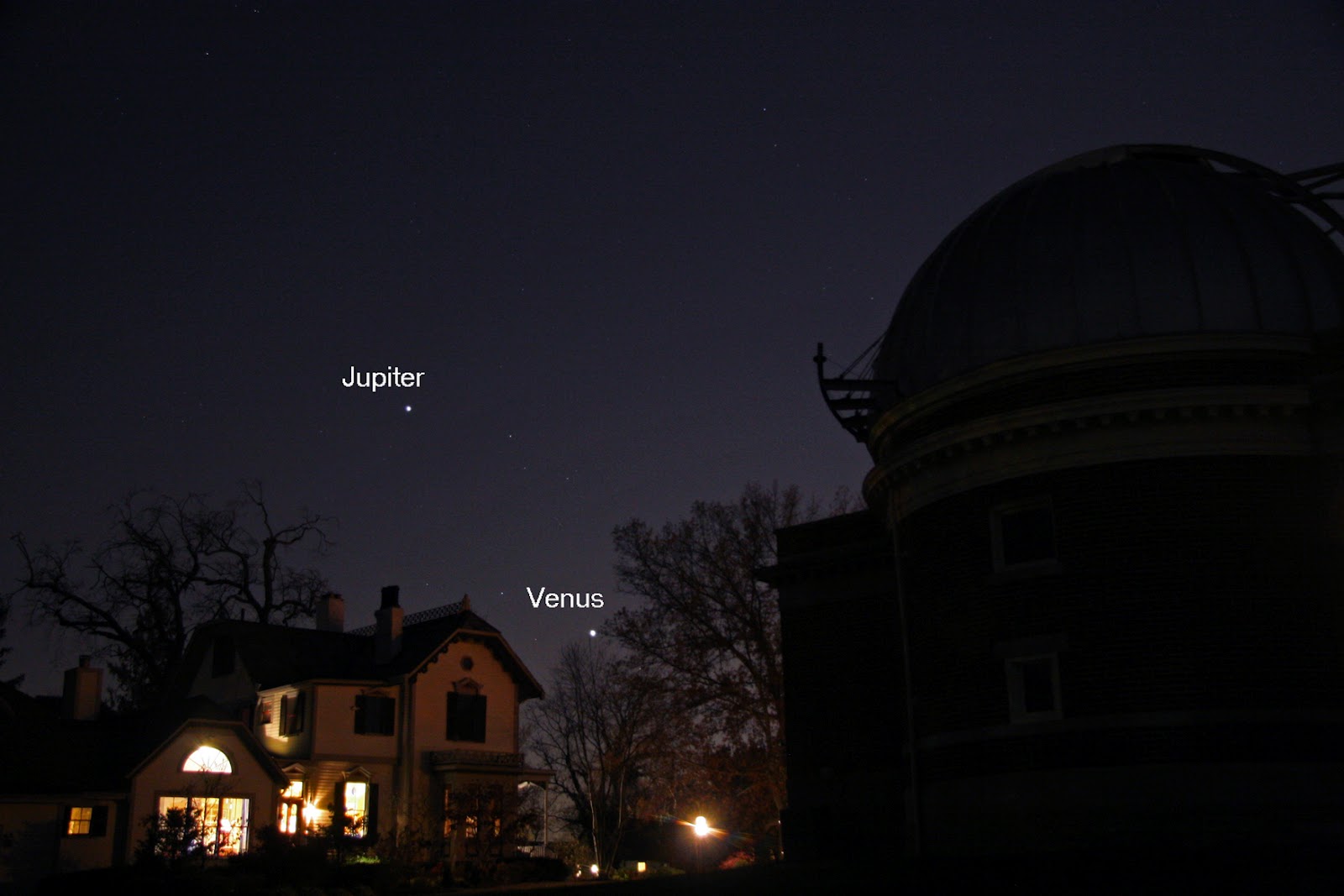
We have had a great week of viewing for the planetary conjunction.  Venus and Jupiter have switched places and now Venus is the one higher in the sky as darkness falls.  This picture was taken on March 14 by a visitor to the Cincinnati Observatory, Bill Keel.  You can see the old Mitchel Telescope pointed through the dome with Venus on the right, Jupiter on the left (click on it for a bigger version).

For the rest of the month, the two planets will appear to spread out in the sky.  Jupiter will be the first to ride off into the sunset later in April.  But Venus will be blazing away in the western sky until mid-May.

After you've found Venus and Jupiter, turn 180 degrees.  In the opposite sky you'll find a pretty bright star that is decidedly "redder" than the others (hint hint).  That's the planet Mars.  And if you can stay up a little later, Saturn rises with a blue star next to it (called Spica) at about 11:30 in the southeast. So this weekend see if you can catch four planets in one night!
-

Thursday, March 8, 2012

Super Planetary Conjunction

(Click on it to see Jupiter's Moons)
I've been looking forward to this all year!  The two brightest planets, Venus and Jupiter, are coming together for a dramatic planetary conjunction. 

You've probably noticed them in the western sky after sunset.  Venus has been the brighter object lower in the sky.  People often mistake it for a plane or UFO - it's that bright!  Jupiter is dazzling as well, but not as bright as Venus and higher in the sky. 

Each night they appear closer and closer together in the sky, until Monday March 12 and Tuesday March 13 when they will be right next to each other.  After the 13th, Venus will be the higher of the two planets as Jupiter heads off into the sunset. 

Conjunction from the Observatory
They will only appear to be next to each other.  In reality Venus will be about 76 million miles from us while Jupiter will be a whopping 522 million miles distant.  Venus (only 1/11 the diameter of Jupiter) appears brighter because it's that much closer.

There is something mesmerizing about the combination of these two with a gorgeous sunset.  The golden lights of the planets in front of the deep blue March sky is amazing.  Be sure to check them out over the next few weeks and say, "Hi," to the planets!
- 

Wednesday, February 15, 2012

Tale of Two Clusters in Taurus

Hyades - Do you see the "V?"
Don't worry, Taurus the Bull isn't sick.  He's just got a cluster of stars on his face and another cluster on his back. 

Finding the Bull is pretty easy.  Look for a long, skinny “V” shape above and to the right of Orion. The “V” marks Taurus’ head and long horns as he is about to trample brawny hunter.

If you are still having trouble, find the three stars which mark Orion’s belt and use them as pointer stars. Connect the three dots and continue this line to the right. This line will take you just under a bright, orange-colored star. That is Aldebaran, or the bull’s eye.

How you find the clusters
You'll notice Aldebaran is redder than other stars – “A ruby of dazzling hue.”  And if you look closely you'll see lot of fainter stars all around Aldebaran and the "V" shape.  These are the Hyades star cluster.  All of these stars (except Aldebaran) are about the same distance away and were formed from the same nebula.  They're the closest open cluster in the skies and that's why you can see them with the naked eye.  The ancient Greeks thought they were the five daughters of Atlas who cried all the time over the death of their brother Hyas.  Ever since then, the Hyades have been associated with rainy seasons.   

The name Aldebaran is an Arabic word loosely translated as “The Follower”. What is Aldebaran following? Just continue that line from Orion’s belt past Aldebaran and you will see the most impressive cluster of stars, the Pleiades.

Close up of both clusters
 Maybe you’ve heard of the Pleiades from their alias, the Seven Sisters. At first glance, the stars in the Pleiades look more like a little cloud the size of the full moon. But upon closer examination, you may detect five, six, or seven individual stars in the group. With binoculars you can see approximately 50 stars in the cluster, and with a telescope you can count all 500 of them.  We'll talk more about the Seven Sisters next week, so tune in!
- 


Thursday, February 9, 2012

Aries the Ram

Aries is a small, but easy to find zodiac constellation visible in the winter sky. The star picture only has 3 bright stars but they form a distinct obtuse triangle in the sky 25 degrees to the right (or west) of the Seven Sisters star cluster. And this year, the bright planet Jupiter is nearby (just down and to the left after sunset). The brightest star is named Hamal, the head of the sheep.

For such a tiny constellation, Aries has an extensive mythology. Part one occurs when a king, with a son named Phrixus and daughter named Helle, leaves his wife and remarries a mean and nasty woman. The new wife is jealous of the children and plans to sacrifice them to the gods. Talk about your wicked step-mothers! At the last moment their biological mother sends a magical, winged, golden ram down to fly them away to the east. Unfortunately the daughter falls off of the flying ram to her death in the Hellespont (named in her honor).

Phrixus lands safely and sacrifices the ram to Zeus (thanks O Flying Ram) and gives the golden fleece to another King named Aeetes (whose daughter he eventually marries). The King put the fleece under constant protection guarded by a fierce dragon that never slept. The stage was now set for a man named Jason to make an epic journey to steal this Golden Fleece.

To be continued…
-

Thursday, February 2, 2012

Aries as the Golden Fleece

Not long after King Aeetes got the Golden Fleece, an expedition was formed to take it from him. A man named Jason, heir to the throne, needed to accomplish a dangerous task to boost his self-esteem. As a kid he read countless stories or daring deeds and courageous adventures. However, he was a rather wimpy kid who was picked on even in kindergarten. When he heard about the Golden Fleece, Jason vowed to face all dangers and bring it bravely back to Greece. So he gathered a group of explorers called the Argonauts to go with him (The Argonauts were named after the ship - Argo - that bore them to the fleece. The group included such A-listers as Heracles, Orpheus, Castor and Pollux.  The Argo was also an old constellation covering the southern sky now broken up into 6 modern constellations).

Medea, a woman possessed
After facing Harpies, pointy rocks, and mild seasickness Jason made it to the King Aeetes. Aeetes, of course, didn't want to give the fleece away. It still had that new fleece smell. But the King's daughter Medea, caught under a spell from Aphrodite, stood up for Jason. Medea helped him plow a field with fire-breathing bulls, defeat warriors that grew from dragon's teeth, and put a stalwart dragon to sleep to finally gain the fleece. In fact, Medea did all the work - mixing potions to entrance her enemies. Jason took the fleece and Medea back home with him where they did not live happily ever after. Once Aphrodite's spell wore off, Medea and Jason broke up... Alas, love is so fickle.
-