|
| Medea, a woman possessed |
-
|
| Medea, a woman possessed |

 Orion is the constellation that conjures the deepest imagination and wonder with just one glance. Something about the placement of the stars ties the entire picture together. Not to mention his 3-star-studded belt. Almost every culture in the ancient world associated these stars with a hunter, giant, or all-around he-man.

 And there are sometimes where I look at the stars above and picture a particular rock n' roll icon with a snazzy belt and sparkly rhinestones. Instead of a club, he's holding a microphone. Yes, to me Orion is the Great Elvis in the Sky! Look at that belt...

 I and fellow Star Gazer host, Marlene Hidalgo, gave a running commentary, answered questions from viewers and interviewed some special guests during the eclipse from 4:00-7:00am. The weather was perfect for viewing the eclipse from its start to totality when the Moon set behind the mountains west of Reno. I always love that first moment of the eclipse when the dark shadow of the Earth can first be seen on the Moon’s surface. But near before totality, it really turned orange fast. During totality the color wasn’t as dramatic. In fact I thought it to be a very gray eclipse. A lot of the redness increased as the Moon got lower in the sky. It was a great experience to chase this eclipse, and share it with so many people who couldn’t see it. You can find a sped up video of the eclipse at: http://video.wpbt2.org/video/2176957576/
 I was always fascinated by the names of the stars. Who named them and what were they thinking about? The most famous star in Orion is, of course, Betelgeuse. People pronounce it in many ways, but I prefer "Beetle-juice." The name is Arabic in origin and means the "Armpit of the Great Central One." Betelgeuse is a red supergiant star nearing the end of its lifetime. When it goes, it will make a huge blast. And it probably will be stinky.
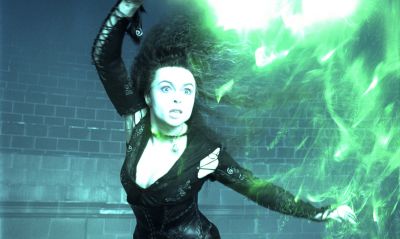 |
| Bellatrix Lestrange |
 |
| Bellatrix "Le Star" |
 Sometimes I like the names of stars and their origins just as much as the mythologies of entire constellations. So let's take a closer look at four stars in Pegasus the Flying Horse.
 I can picture Andromeda discussing the matter with the gods. Zeus might say, "Well, it's getting pretty crowded up there in the sky - what with all the new constellations." After a thoughtful pause he continues, "The only empty space is up there by Pegasus' belly. We'll just have to squeeze you up in there..."
 One of the great fall constellations is Pegasus the Flying horse. He's easy to find in the sky if you're prepared to imagine him flying upside-down. Look for a big square or diamond shape of dim stars almost straight overhead. As an added clue there are very few stars within the square. This is Pegasus' body. His head and mane are to the right from the square.
 -
 Our hero Perseus (remember him), was flying through the air, borne on his winged sandals. He was feeling quite proud of himself since he just killed Medusa earlier in the day. Suddenly he hears a scream and looks down to see a young maiden chained to a rock about to be devoured by a sea monster. Perseus thinks, "Man, does it get any better than this?" Not only did he kill Medusa, but now he can save a maiden in distress.
 The constellation Cetus the sea monster can be found basking on the shores of Eridanus, the river constellation. Look for a group of stars that look like a recliner chair to the right of Perseus and below Pegasus. What about Pegasus? Tune in next week...