Showing posts with label Planets. Show all posts

Monday, April 30, 2012

IT'S SATURN SEASON

Right click on this and open in a new window and try to find the Earth!

The rings of Saturn are open for business.  As we head into May, the plane, its 170,000 mile-diameter ring system, and multitude of moons are back in prime-time for you to see this month.

You don’t need a telescope to find Saturn.  It shines like a steady, yellow “star” in the southeast near a blue star called Spica.  Here's how you find it:

First find the Big Dipper high in the northeastern sky.  Connect an arc through the handle stars of the Big Dipper and continue that arc to a really bright star called Arcturus ("Follow the Arc to Arcturus!").  Then keep going in a straighter line along the horizon and bingo you'll find Saturn and Spica ("Speed on to Saturn").

A Saturnian Storm
Now to see the rings, you’ll need to look through a good telescope.  Then you can witness the opening season of the solar system’s greatest wonder.  You can see the planet, the rings, the shadow of the rings, the gaps in the rings, the moons... Okay, I'm getting a little excited here, but this is the best planet ever.  When I first saw Saturn in a telescope it changed my life.  There it sat, a perfect cartoon-planet in a sea of blackness.  I knew then that I was destined to be an astronomer.  Check it out tonight!
-

Friday, March 16, 2012

Venus and Jupiter Putting on a Show

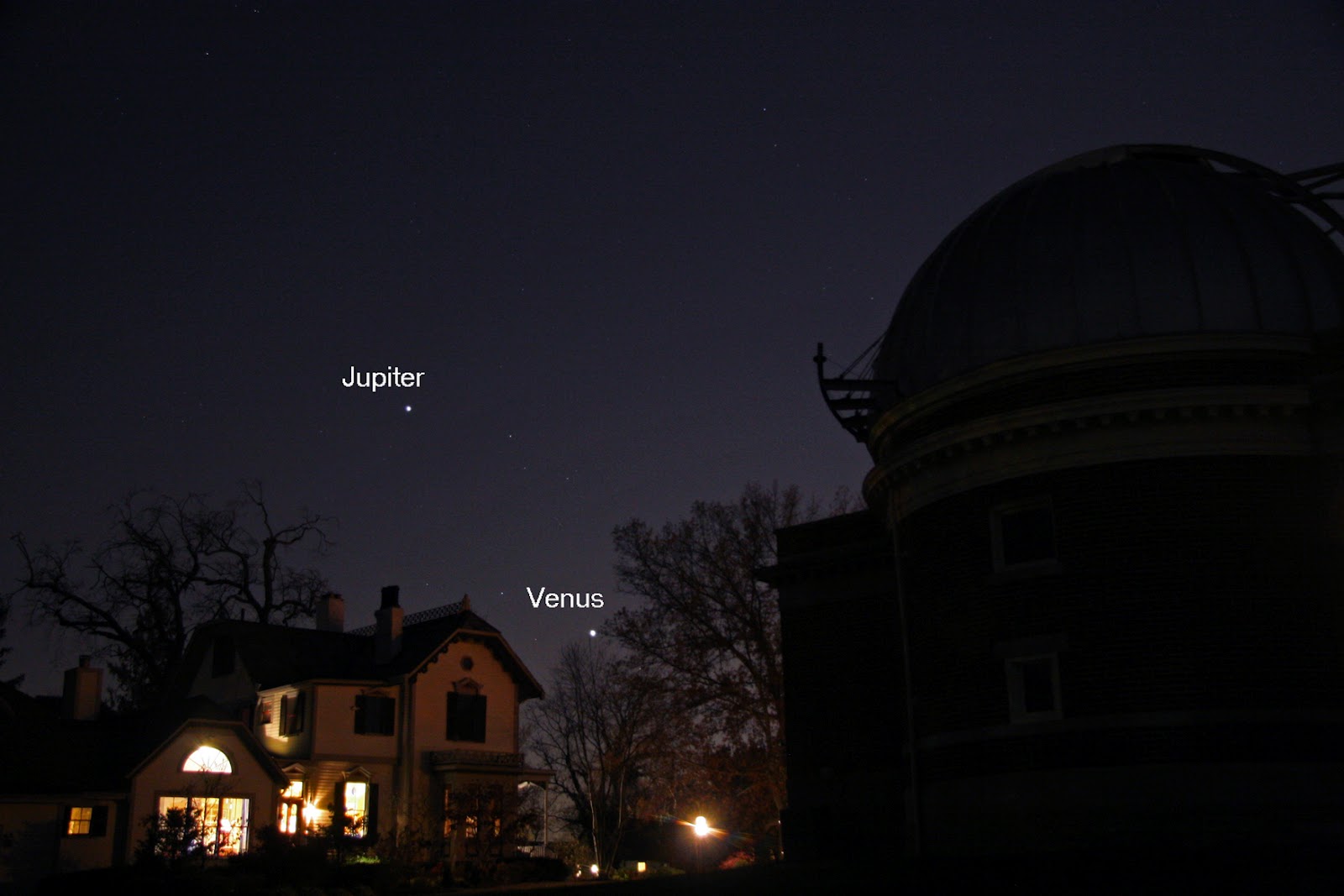
We have had a great week of viewing for the planetary conjunction.  Venus and Jupiter have switched places and now Venus is the one higher in the sky as darkness falls.  This picture was taken on March 14 by a visitor to the Cincinnati Observatory, Bill Keel.  You can see the old Mitchel Telescope pointed through the dome with Venus on the right, Jupiter on the left (click on it for a bigger version).

For the rest of the month, the two planets will appear to spread out in the sky.  Jupiter will be the first to ride off into the sunset later in April.  But Venus will be blazing away in the western sky until mid-May.

After you've found Venus and Jupiter, turn 180 degrees.  In the opposite sky you'll find a pretty bright star that is decidedly "redder" than the others (hint hint).  That's the planet Mars.  And if you can stay up a little later, Saturn rises with a blue star next to it (called Spica) at about 11:30 in the southeast. So this weekend see if you can catch four planets in one night!
-

Thursday, March 8, 2012

Super Planetary Conjunction

(Click on it to see Jupiter's Moons)
I've been looking forward to this all year!  The two brightest planets, Venus and Jupiter, are coming together for a dramatic planetary conjunction. 

You've probably noticed them in the western sky after sunset.  Venus has been the brighter object lower in the sky.  People often mistake it for a plane or UFO - it's that bright!  Jupiter is dazzling as well, but not as bright as Venus and higher in the sky. 

Each night they appear closer and closer together in the sky, until Monday March 12 and Tuesday March 13 when they will be right next to each other.  After the 13th, Venus will be the higher of the two planets as Jupiter heads off into the sunset. 

Conjunction from the Observatory
They will only appear to be next to each other.  In reality Venus will be about 76 million miles from us while Jupiter will be a whopping 522 million miles distant.  Venus (only 1/11 the diameter of Jupiter) appears brighter because it's that much closer.

There is something mesmerizing about the combination of these two with a gorgeous sunset.  The golden lights of the planets in front of the deep blue March sky is amazing.  Be sure to check them out over the next few weeks and say, "Hi," to the planets!
- 

Tuesday, July 5, 2011

NEW STAR GAZER EPISODES

 Great news!  I have been selected to be the permanent co-host of the new Star Gazers TV show!  The Star Gazers will feature me and astronomer James Albury from the Kika Silva Pla Planetarium in Gainesville, Florida on your PBS stations and online.  We will continue the tradition of Jack Horkheimer's Star Gazer and let you know "What's Up" in the night sky as well as demo new graphics and effects that will take you the edge of the universe, explain the workings of the heavens, and have you back in time to step outside and see it all for yourself.  Star Gazers will debut on October 4, 2011.    

In the meantime, I filmed classic Star Gazer episodes for July and will be back on in September as well.  To see the one-minute and five-minute shows for this week entitled "Planets, Planets Everywhere," right click on the links below and select, "Open in New Window"


For the archive of past shows, please do the same for Jack Horkheimer's page: http://www.jackstargazer.com/JHSG_DNLD.html

Keep looking up!