Showing posts with label Venus. Show all posts

Wednesday, May 29, 2013

CHANGING PLANETARY TRIANGLE

The planetary conjunction isn't over yet.  Venus, Jupiter, and Mercury will be hanging around in the west-northwestern sky for a few more days.  Last night I saw them less than 10 degrees above the horizon but could follow them all the way to sunset.  On the night of May 26th they made a perfect equilateral triangle as shown by the picture below.


Over the next few days, Venus and Mercury will appear higher at the same time of night while Jupiter sinks lower.  Venus is the brightest of the three, followed by Jupiter, and then Mercury.  Over the next few days Venus will slide between the other two turning the former triangle into a planetary lineup.  May 31 and June 1 they will be best aligned.  Jupiter will be at the bottom, Venus in the middle, and Mercury at the top.  Both Mercury and Venus and Venus and Jupiter will be separated by only 4 degrees.  On June 1, Mercury will be the closest of the three at about 95 million miles away, Venus is on the other side of the Sun from us still so it's about 151 million miles distant, while Jupiter is way out as usual - 567 million miles away.

Jupiter will be heading off into the sunset soon so don't miss it.  Mercury will hang around for a few more weeks and make a close conjunction with Venus on the night on June 18 and 19.  But Venus will be low in the evening skies for the next several months.  In fact, she'll be there even as you ring in the New Year 2014.

To see the planets you will need an extremely clear view to the west-northwest horizon.  No trees, buildings or anything can be in your way.  And you have to be there right after sunset.  Once the Sun sets you only have 30 minutes to catch the planets pop out from the sky glow before they set.

Happy Planet Hunting!
-

Thursday, August 9, 2012

LUNAR OCCULTATION MONDAY

Eclipses, Transits, Blue Moons, Supermoons - 2012 has it all.

Add an occultation to the list.  This is when the Moon or a planet goes in front of something else (a star, other planet).  I have only seen three of these in my life (compared to nine lunar eclipses).  So the rarity of these is way up there. 

On Monday August 13 the Moon will occult (go in front of) the planet Venus.  The good news is we'll see it from the Cincinnati area (and across the country west of us).  The bad news is that it will happen during the daytime.  The main event will be between 4:41-4:42 PM EDT.  That's all the time it will take for the Moon to cover Venus. 

To find it, look west at 4:15pm for the waning crescent moon.  You might just barely be able to make it out in the afternoon skyglow.  If you have eagle eyes, see if you can see a dot to the upper left of the Moon.  That's Venus.  In the spring I was able to find Venus in the daytime sky with the naked eye - when the Moon was nearby as a reference. 

Then at 4:30pm get out your telescopes and aim them at upper left part of the Moon.  You should be able to see Venus there as well.  It will look like a little half moon in a telescope (it goes through phases too).  In apparent size, Venus will be dwarfed by the huge-looking, much closer Moon.  Then watch as the Moon gets closer and closer until... occultation.

Unfortunately in Cincinnati we won't be able to see Venus pop out the other side because the Moon will have set by then.  So tell people on the west coast about it and they'll see both the entry and exit of Venus behind the Moon.

Enjoy the Lunar Occultation of Venus.
-  

Monday, July 9, 2012

YOUR WEEKLY STARGAZING REPORT

I'm hosting a short piece for WXIX, channel 19, our local Fox TV station, called, "Stargazing Report."  I will tell you about the highlights of the week - what to see, where to look, and when.  You don't need a telescope or binoculars to find the Moon, planets, and bright stars.  The piece runs almost as an accessory to the weather every Monday at 4:20am (yes, they have a show that early).  Luckily they are pre-recorded - so I don't have to get up that awful early.

For night owls like me who can't wake up that early, (or if you miss it) Fox 19 has added the feature to their website.  Now you can watch it anytime to see what's coming up.  Open this link in a new window and let me know if you have any astronomical questions: http://www.fox19.com/category/242740/stargazer-report-with-dean-regas     The show for the week of July 9-15 is below.  We have Jupiter, Venus, and the bull's eye star, Aldebaran making a nice triangle in the morning sky all week.  Then the waning crescent joins the triangle on Sunday morning.  Check it out! 


Wednesday, June 13, 2012

TRANSIT OF VENUS 2012

Thoughts on a Twice in a Lifetime Event

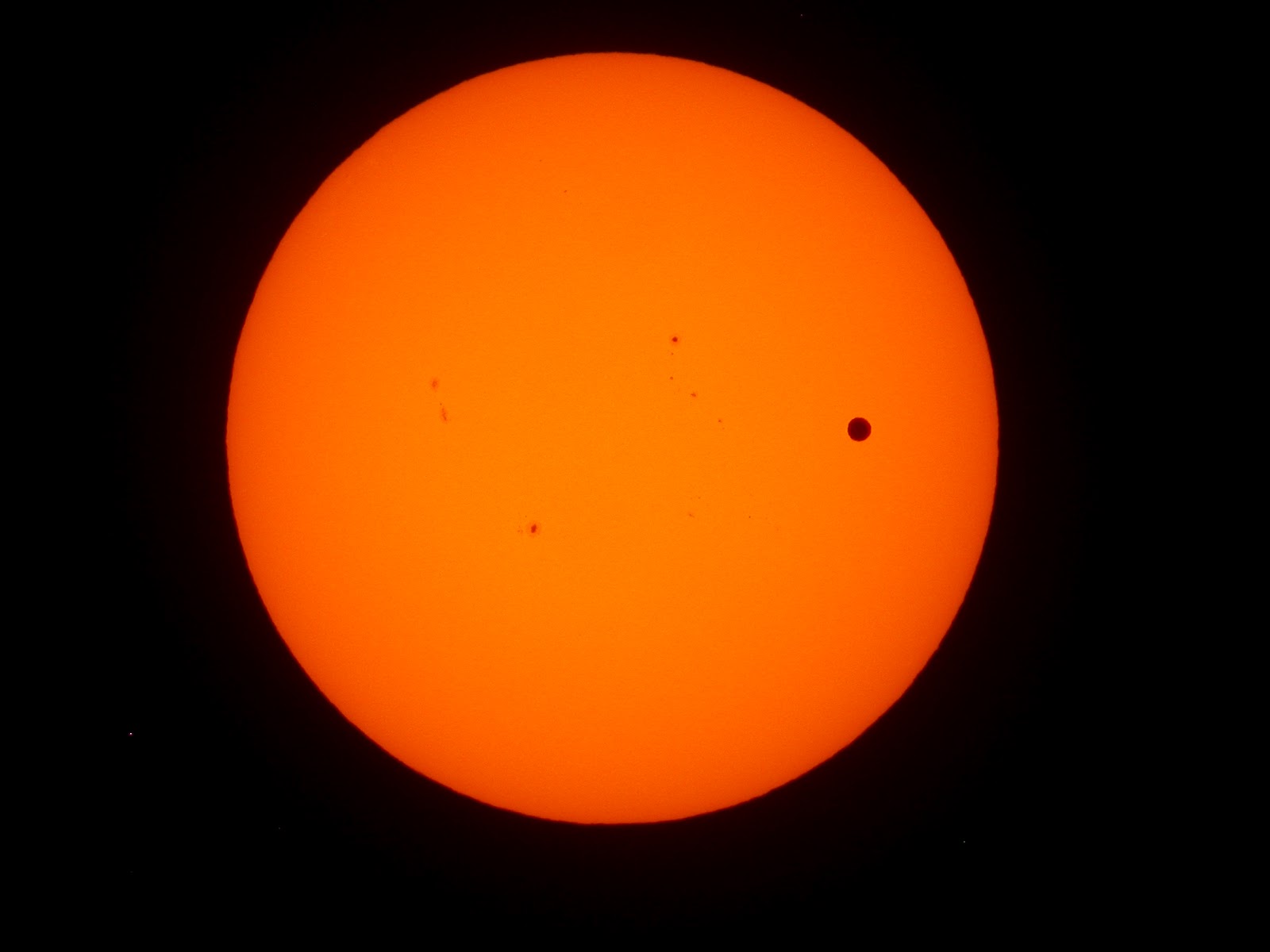
Tuesday’s Transit of Venus was the last time I will see the beautiful planet cross in front of the face of the Sun. I already miss her.

Sure I’ll be able to see Venus again in only a few short days as she pops out into the pre-dawn skies but she won’t be the same. A Transit of Venus has transformed her. This rarest of astronomical events changes your perspective not only the planets but the history of the universe.

A Transit of Venus only occurs when the planet Venus comes directly between the Earth and Sun. Much more subtle than a solar eclipse, the Transit of Venus is unique because of its precision, its history, and its rarity. The Sun, with Venus as a small beauty mark marching slowly across its behemoth face, has been noted just seven times in human history.

For the Transits of the 1700s and 1800s, astronomers sailed around the world to catch a glimpse of it. In 2004 I drove my Geo Metro to New Hampshire to see it over the Atlantic Ocean at sunrise. And on Tuesday I flew on a Delta jet to Arizona to witness the event over the stark, high desert. Millions of people watched the various Transit webcasts from around the world. My journeys in 2004 and 2012 and those virtual journeys would have been unthinkable to those viewing the Transit of 1882.

After the Transit of 1882, the last one prior to 2004, an editorial ran in the New York Times musing about the future when “the June flowers are blooming in 2004.” It said, “When the last transit season occurred the intellectual world was awakening from the slumber of ages and that wondrous scientific activity which led to our present advanced knowledge was just beginning. What will be the state of science when the next transit season arrives God only knows.”

Our scientific knowledge in astronomy progresses so rapidly that discoveries are made daily. The next Transit of Venus won’t be until the year 2117 and even that one won’t be visible from Cincinnati. Our ancestors will have to travel to Asia, Australia, or Africa to see it. How will they get there? What will life be like 105 years from now? In the 22nd century will space tourists watch Transits of Venus far above the Earth any day they choose?

Even as an astronomer it’s hard to wrap my mind around distances, cycles, and expanses of time that are, well, astronomical. But I am reassured that no matter what may happen on Earth, the Transit of Venus will occur again on December 10, 2117 and December 8, 2125. To those witnessing the next pair of Transits in the 22nd century under the December Sun, in a future I can’t begin to imagine, I wish you clear skies and the same spectacular view that we had twice in the 21st century.
-

Thursday, May 31, 2012

IT'S TRANSIT TIME

Last Transit of Venus this Century

On Tuesday June 5, the planet Venus will go in front of the Sun.  Although not as dramatic as a solar eclipse, a Transit of Venus is so rare that it has only been noted six times in human history!  The Earth, Venus, and Sun have lined up for astronomers in 1639, 1761, 1769, 1874, 1874, and 2004.  And the next one will be 2117 (do you get the pattern?). 

In 2004 I traveled to New Hampshire to see it as the Sun rose.  I was met by fog that blocked out the Sun!  I almost panicked (okay, I did panic), but luckily the fog parted enough for me to view the very end.  That's the picture I took through a telescope with a solar filter.  It's like a little black spot on the Sun.  Now I want another shot at it...

The timetable for June 5th is this:
       Transit begins at 6:04pm EDT
           It will slowly march across the disc of the Sun until...
              Sunset.
                   Check your local sunset for exact times and make sure to have a clear view to the north-western horizon.

It's never safe to look at the Sun so always use proper solar filters.  For six cool, safe ways to view the event, see: http://transitofvenus.nl/wp/observing/six-ways-to-see-the-transit/

If it's cloudy where you are on June 5, you can watch the Transit of Venus on a live webcast at: http://www.ustream.tv/star-gazers-eclipse  

Everyone in the United States and most of Canada will be able to see the event.  I'm heading to Arizona in the hopes of making use of the clear, desert skies (with no fog).  Hopefully I'll have some great pictures to share after June 5 because I'm not gonna make it until 2117.

Happy Transit of Venus!
-

Tuesday, March 27, 2012

The Pleiades - Myths from around the World

 The Pleiades are the brightest open cluster in the northern sky and have fascinated people since the beginning of time. They are represented in ancient mythology of many cultures. Most myths relate the Seven (or Six) Sisters to young maidens or boys playing, dancing or just being young and wild, “Like a swarm of fireflies tangled in a silver braid.”

Let's look at what other people called these stars:

China - The Seven Sisters of Industry
Japan - Subaru (look closely at the logo of these cars)
South America - Cajupal, the Six Stars
Australian - Young girls playing music for the dancing young men (in Orion’s belt)
India - The Flame
Native American - Seven young men guarding the holy seed of agriculture/Or seven dancing children
Eskimo - The Bear
Hottentots - wives who kicked their husbands out because they were poor hunters
Borneo - mother and six chicks

The Pleiades are also featured heavily in All Hallow’s Eve celebrations - when they are highest at midnight. Aztecs, Mayan, Peruvians, Japanese, and Hindus all had festivals for the dead near November 1 in honor of the Seven Sisters. 

You can find them very easily.  Look west after sunset and you should see a little cloud hovering above the ground.  When you take a closer look you should be able to make out 5 or 6 of the stars.  A sharp-eyed second grader called it the "Dinky Dipper."  What do you think?  And Venus is nearby - that brightest of planets.  On April 2nd and 3rd Venus will be right next to the Pleiades.  Get out your binoculars and check them out!

Friday, March 16, 2012

Venus and Jupiter Putting on a Show

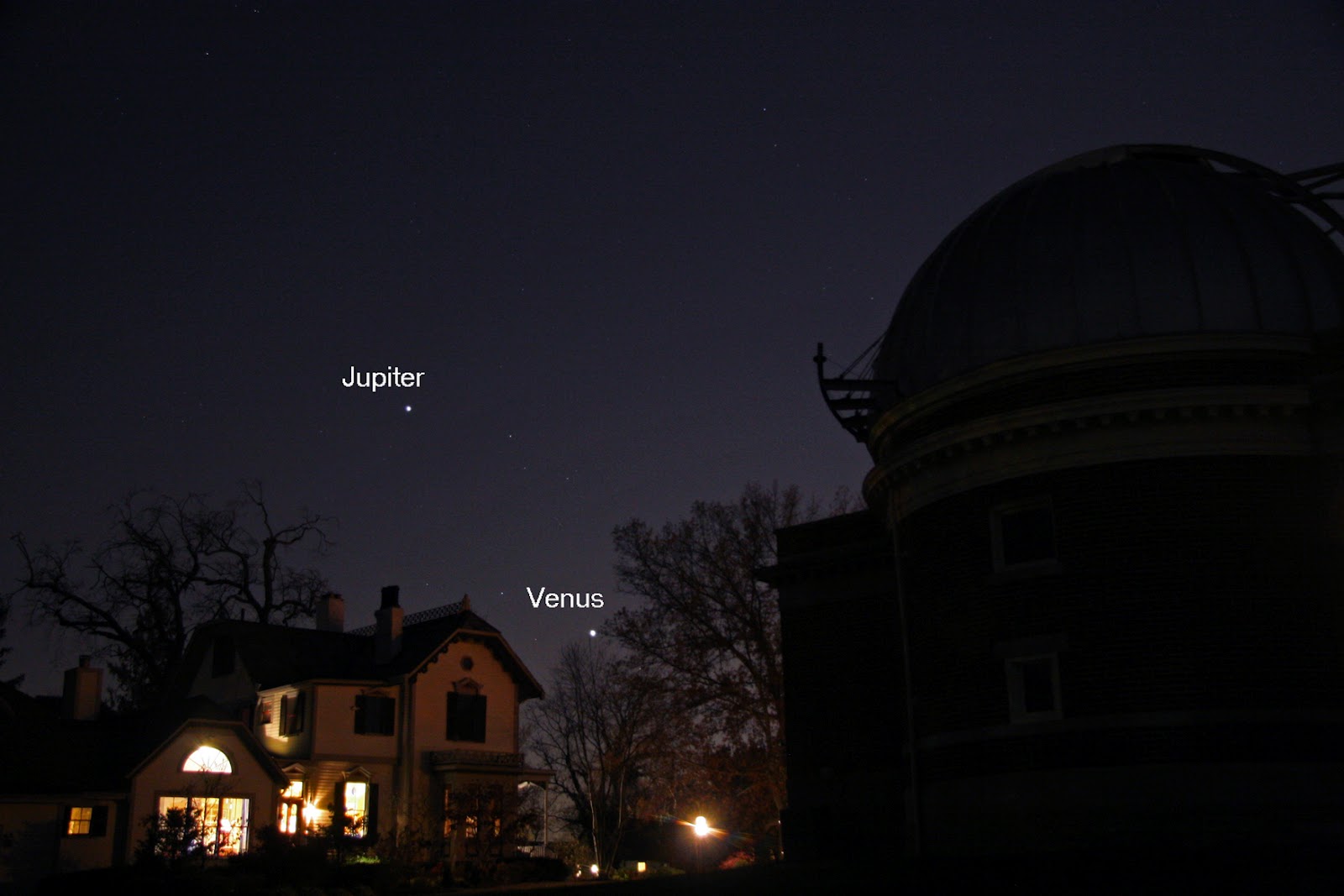
We have had a great week of viewing for the planetary conjunction.  Venus and Jupiter have switched places and now Venus is the one higher in the sky as darkness falls.  This picture was taken on March 14 by a visitor to the Cincinnati Observatory, Bill Keel.  You can see the old Mitchel Telescope pointed through the dome with Venus on the right, Jupiter on the left (click on it for a bigger version).

For the rest of the month, the two planets will appear to spread out in the sky.  Jupiter will be the first to ride off into the sunset later in April.  But Venus will be blazing away in the western sky until mid-May.

After you've found Venus and Jupiter, turn 180 degrees.  In the opposite sky you'll find a pretty bright star that is decidedly "redder" than the others (hint hint).  That's the planet Mars.  And if you can stay up a little later, Saturn rises with a blue star next to it (called Spica) at about 11:30 in the southeast. So this weekend see if you can catch four planets in one night!
-

Thursday, March 8, 2012

Super Planetary Conjunction

(Click on it to see Jupiter's Moons)
I've been looking forward to this all year!  The two brightest planets, Venus and Jupiter, are coming together for a dramatic planetary conjunction. 

You've probably noticed them in the western sky after sunset.  Venus has been the brighter object lower in the sky.  People often mistake it for a plane or UFO - it's that bright!  Jupiter is dazzling as well, but not as bright as Venus and higher in the sky. 

Each night they appear closer and closer together in the sky, until Monday March 12 and Tuesday March 13 when they will be right next to each other.  After the 13th, Venus will be the higher of the two planets as Jupiter heads off into the sunset. 

Conjunction from the Observatory
They will only appear to be next to each other.  In reality Venus will be about 76 million miles from us while Jupiter will be a whopping 522 million miles distant.  Venus (only 1/11 the diameter of Jupiter) appears brighter because it's that much closer.

There is something mesmerizing about the combination of these two with a gorgeous sunset.  The golden lights of the planets in front of the deep blue March sky is amazing.  Be sure to check them out over the next few weeks and say, "Hi," to the planets!

Thursday, March 10, 2011

STAR GAZER Programs for March

I’m back from Miami Florida where I filmed another eight episodes for the iconic astronomy program – STAR GAZER. This is the show you see late at night on PBS where a guy stands on a light beam and tells you, “What’s Up,” in the sky. Well, for the third month, that guy has been me! I can hardly believe it - but now I’m able to share my passion for the night sky on 1-minute and 5-minute segments aired on over 90 TV stations around the globe. If you’d like to watch them, they’re on YouTube. I wrote Finding Direction in the Night Sky – where I get to tell my classic myth jokes. Check them out, “Like” them, and post comments please:

March 7-13 The Biggest Full Moon in 18 Years
5-minute: http://www.youtube.com/watch?v=eycsw-DZ9wg  
1-minute: http://www.youtube.com/watch?v=3Ng2wT3Azdw  

March 14-20 Finding Direction in the Night Sky
5-minute: http://www.youtube.com/watch?v=X7-bTOKeCUE  
1-minute: http://www.youtube.com/watch?v=A6AQAJ-pt9M  

March 21-27 Venus and the Moon at Dawn
5-minute: http://www.youtube.com/watch?v=WsZAg7VnPh4  
1-minute: http://www.youtube.com/watch?v=3n7lIM2ptro  

March 28-April 3 Arcturus and Saturn Join the Moon and Pleiades
5-minute: http://www.youtube.com/watch?v=mnqBioC7Fh4  
1-minute: http://www.youtube.com/watch?v=IgHwMujAY2Q  


You can download all of your favorite Star Gazer programs at: http://www.jackstargazer.com/JHSG_DNLD.html

If you don’t get Star Gazer on local your PBS station – let them know about it. The program is free for anyone to broadcast. Spread the word!
-

Thursday, December 10, 2009

Pisces the Fish

Enough 2012 stuff, let's get back to the constellation mythology.

To the left of Aquarius is the zodiac constellation Pisces the Fish. If you thought Aquarius was hard to find, Pisces is even worse. The stars are all so faint that they are only visible from a dark sky away from city lights. There is a ring of stars for one fish that's tied by a string a stars to another fish left and then up from the first fish. It looks like an "L" drawn with the base too long. Where the cord bends, you will find a star called Al Rischa which means, "The Knot of the Band."
-
The story behind Pisces is related to the one about Capricornus. A long time ago the gods were terrorized by a roving monster named Typhon. He was such a horrible creature with 100 dragon heads instead of fingers. When Typhon came around all of the gods hid by changing into animals. Apollo turned into a crow, Diana into a cat, and Venus and Cupid (the gods of love) turned into fish. They jumped into the Euphrates River to escape Typhon but tied their tails together so that that would never be parted.
-
Pisces is part of a very watery part of the sky that includes Aquarius the Water Bearer, Piscis Australis, and the fish-half of Capricornus. I don't believe in astrology but the Sun does go through Pisces from March 12 to April 18. If you were born between those dates, according to an astronomer, you're a Pisces.
-